Tampilkan postingan dengan label new. Tampilkan semua postingan

Selasa, 21 Juni 2016

Potty training your new puppy

0


Training should begin immediately after you have gotten home with your new pet. Training your dog is beneficial to both you and your pet. These suggestions will help you in your pet training efforts.

Introduce new animals to one another very slowly. Weighs the pros and the cons before adopting another pet. For optimal bonding, select a new pet whose personality is similar to that of your current pet.

 Stay consistent when you are trying to train your dog. Make sure everyone knows the right commands to give the dog; keep a list if necessary. Behavior should be rewarded or not depending on the affect that is being sought. Your dog will become very confused if each person responds differently to a single type of behavior. This will make training very hard.

 When you are house training a dog, you may want to use a crate. Let the dog out on a regular schedule to make the crate training most effective. Once your dog has acclimated to the crate, he will be far less accident-prone indoors.

 Dogs have the uncanny ability to have single-minded focus when something catches their attention. Repetition and practice will result in your dog waiting to take cues from you rather than being distracted by other things.

 Everyone in your household needs to be on board for dog training to be effective. While he may have one person who works with him on a regular basis, having everyone be a part of his training will teach him that he must follow the rules of the house at all times, and keep his training more consistent.

 Always get your dogs attention by using his name. To train your dog, you need a certain level of control. Getting them used to their name and coming when you call will help you achieve this. Repeat this several times daily. Also, dont punish your dog if he comes over when you call him by name.

 Teach your pet the proper way to walk on a leash. When they walk properly, it makes both of you safer when you both go walking.


 You need a commanding control if you are starting to train your dog. Your dog will neither obey nor respect you if he believes he is the leader of your household. Never allow your dog pull on the leash while you are on a walk.

 Although there are many benefits to using a harness, you will have less control over your dog than if he is wearing a cinch collar. If you plan on using a harness outside of training, put both that and a collar on your dog during the training process. This will teach him to respond to commands even after the cinching collar is removed.

 Using wee-wee pads is actually counter productive when you are potty training your new puppy. The problem with the wee-wee pads is that they leak and leave enzymes from urine and feces behind. Potty pads can also mislead your dog into thinking that similarly shaped items throughout your home, like rugs, are appropriate places to go. The best option is to toilet train your dog outdoors.

 Do not wear out your new puppy with an excessive training regiment. Remember that all dogs have short attention spans and puppies even more so. Hell likely forget everything you taught him if you do too much at once. He will also look at training as a negative experience and it will be harder next time.

 Choose from a range of treats to give your dog as training reward. These treats cannot be confused with every day treats at first, because you need to create a sense of specialness which will encourage the dog to obey your commands, since they know that the treats they will be receiving are out of the ordinary.

 Every dog is unique and is motivated to learn by different things. Dog training can be a learning experience, especially with it comes to determining what motivates your pet. It doesnt matter the reason you want to train your dog, you need to offer a variety of exercises along with positive reinforcement. Any time your dog is happy, you will find they have a better performance.

 Challenge your dog frequently. Give him "quizzes" to make sure he still knows his stuff, even if you both know he does.

 Dogs are just like people; they love hearing the sound of their own names and the use of the name will call them to attention. It is especially important to do this during the first weeks of training, in order to establish that name-attention association. Make the name simple and easy for the puppy to recognize.

 Use your dogs name when you can, as it will help to get your dog to pay attention. By using it as much as possible during the first weeks you own him, your puppy will learn that this sound is in reference to him. Choose a short name that is easily recognizable from other words.

 You do not want to use wee-wee pads when potty training your dog. The problem with the wee-wee pads is that they leak and leave enzymes from urine and feces behind. Potty pads can also mislead your dog into thinking that similarly shaped items throughout your home, like rugs, are appropriate places to go. Teaching your dog the appropriate place to go from the start is always the more practical idea.

 Try not to use wee-wee pads as a tool in potty training your day. The problem with the wee-wee pads is that they leak and leave enzymes from urine and feces behind. The pads may also confuse the dog because of their shape. It could cause the dog to think that a bathroom mat or welcome mat is a place to go potty. The best option is to toilet train your dog outdoors.

 A clicker works well when training most dogs. Using a clicker is as simple as showing your dog that good things happen when the clicking noise is heard. Try using this technique right away, doing it frequently over a span of a few days. Your dog will soon know that the clicking noise means that they are doing a good job.

 Dogs that are well trained are normally happy. Use the advice youve read to start training your dog properly..

Read more

Kamis, 09 Juni 2016

Halloween Cometh! And Kikopup is working on a new video

0


We are shooting Kiko, Splash, Tug and Trisch while they act in "Halloween 3" today. Im really excited to start getting it edited!

Read more

Rabu, 08 Juni 2016

You CAN teach an old dog man new tricks!

0

Okay, let me first say hes NOT OLD! My "man" that is... But, he can learn new things... Yep, three years after becoming a trainer and establishing The Inquisitive Canine, a year and a half since opening the studio...and my own husband, father of our dog, love of my life, supporter of all I get into, has finally signed up for one of my classes with our dog Poncho! I couldnt believe it... but he said he finally believes that 1) the training does work, and 2) he needs to learn some of these techniques so Poncho will perform the same behaviors with him as he does with me. 

For years Ive said that dogs dont generalize (perform same behavior in similar situations) - and that we need to re-teach them in any new situation. A new place, person (different person training), situation etc... you have to re-teach the dog...its as simple as that. Im not too sure what finally sent my hubby over the edge of not being convinced to actually "believing", but Im thrilled hes finally there! And that he is excited about coming to class and learning... He even filled out his goal sheet and is reading through his workbook! 

I have to say, this has made my day - and is SO rewarding to me! I love how we positively reinforce one another - makes for a great relationship... Now Id better go catch him in the act of doing what I love and reward him for it! (husband and the dog)... 

Read more

Sabtu, 04 Juni 2016

How to Train Your New Puppy

0


When you get a new puppy, training can be very overwhelming. Sometimes the puppy is just so naughty and so mischievous that you might lose your temper. It is important to remember to keep your puppy training ethical. That means no hitting and trying not to raise your voice. A puppy does not understand what all of that is about. You have to train them in a way that they will be able to learn.

Start Young

You want to start training your puppy at about four weeks old if you have the puppy that early. The training at this point will just be to get them to respond to some sort of cue like a whistle, clap or snap. At six weeks you can start teaching them to walk on a leash and obedience training. It is also important to start crate training young.

Introduce Them to Stimuli

It is important to introduce young dogs to the outside world. You want them to be familiar with toys and floors of all different materials, used to getting touched all over and okay with loud noises of any variety. This will help them behave well even when in new conditions. Some children may approach your dog in the future and touch them on the head, and if your dog is not used to getting touched there it can end badly. It is important to get them used to loud noises for their own benefit. Otherwise they will spend every Fourth of July and thunderstorm cowering in the bathroom in complete terror.

Be Kind

You have to remember through all of your training to praise them when they do things right. You also have to remember that, if you get home and there is an accident, you cannot yell at them. They will not know why you are yelling and they may just get scared.

Difficulties

Training a puppy is not always easy, but you want to make sure that you are doing it ethically. You want to train a well-behaved, loved dog. You cannot do that by treating it improperly. If you need any guidance, there are puppy training courses that you can go to in order to learn tips and tricks to train your dog ethically.

Read more

Sabtu, 28 Mei 2016

A new beginning

0


Since Kiko got her right eye removed she has become a different dog.  Its as though we went back in time to when she was 2 years old.  She is playing more and more active.  Today she kept up with all the other dogs on our hike in the woods,  usually she would walk only a couple of minutes before needing to be carried.  She has been blind in her right eye for some time, so it has not been a shock for her not to be able to see.  So life has only gotten better, as she is not in pain any longer.  The lens of her eye had detached and was knocking into her cornea and even with drops that were supposed to keep the lens in place, she acted miserable.  Her eye used to bother her all the time.  Kiko is a joy to behold.  She is even going up to say hi to dogs she would usually avoid, like an excitable Flat Coated Retriever the other day.  

Read more

Sabtu, 21 Mei 2016

Is a New Pet the Right Gift for the Holidays What to Consider Before Getting One

0

This is such a hot topic right now, dont you think? I hear it every day, "Im going to get the kids a puppy for Christmas. What do you think?" Hmm... Im thinking SO many things, I dont know where to begin. Instead of bursting anyones "Hallmark moment" bubble, I just smile, giggle, and agree that having a puppy (or adult dog, or cat, etc...) is magical - there really isnt anything like the love and joy of a furry friend...trust me!

I get it! Im sitting here right now with mine, Poncho, on a Friday night, playing training games, kissy face, and fighting for the computer...instead of out with my hubby at one of his holiday office parties... but when it comes to buying one for someone else, even if its within the same household, I encourage people to really think hard about this type of "purchase", for both the giver and the recipient(s). 

The following are questions posted by a journalist through a friend of mine: 
  1. Is a new pet a good gift to a child or loved one for the holidays? This is a "yes" and "no" question. If the person on the receiving end is an adult who is expecting one, then I would say it would be a great gift. If its been discussed and planned out then yes. If its for a child in the family, then I would want the entire family to agree to welcoming the new pet, and realize that everyone will be involved, one way or another. 
  2. Should the giver ruin the surprise by asking if the recipient wants that pet and breed before giving it? Definitely yes! Because the recipient not wanting such a "gift" could be a bigger surprise! An alternative would be to give someone items related to the pet they intend to give: books, pictures, toys, etc... along with a "gift certificate" good for "shopping" together. This way if the person really wants this pet, it can be a shared experience, which can be more meaningful. 
  3. What are the dangers/risks/drawbacks of giving an animal as a present? The biggest one is the person doesnt want it, and the innocent animal has to be returned. It can be very traumatic for all involved. The person may want it, but then doesnt realize the responsibility thats involved with owning an animal. Its the pet that ends up suffering the most if it ends up in a neglectful home, even if unintentional. It can also damage the relationship between the giver and recipient if one feels imposed upon or slighted, and neither feels comfortable talking about it. 
  4. What is a more appropriate vs. a less appropriate pet gift to give a child? It really depends upon the child, how involved they intend to be, and how responsible they are. It also depends upon what the parents expectations of the child are. Parents should investigate different types of animals that can be kept as pets, and the needs of that particular animal. Then match it to what the child can do to participate in its care. There are also many toys and virtual games that help build responsibility in pet care. 
  5. Are there any special things the gift giver should do or consider before giving the pet as a present (i.e., they should ensure that the pet has all its vaccinations, is microchipped, etc.)? Assuming that it is a welcomed gift, taking care of the initial health care needs and requirements is always nice. The gift giver may also want to include a items including: a carrier, crate, bedding, proper collars, leashes, car seat-belt, walking harness, food, treats, elimination box if necessary, elimination bags, ID tags, licensing fees, a gift certificate for a veterinarian wellness visit, training class if its a dog, a few toys, books or other information about the specific pet. 
  6. Where should a gift-giver try to get an appropriate pet (i.e., a reputable breeder or shelter)? What sources should the giver avoid? When it comes to adopting a pet or buying a pet, its really up to the individual. There are reputable Web sites that can help the decision making process. With millions of shelter animals being killed every year because of irresponsible breeding, irresponsible ownership, etc... shelters are certainly a good choice. However there are responsible breeders as well, and should be considered if that is the persons desire. The American Kennel Club has information on helping people choose a breeder. 
  7. Is it a good idea to research and suggest a reputable veterinarian/animal hospital in the recipients area at the time you give the pet gift? Yes. This would be a nice gesture for the new pet owners. I would investigate, then provide a list of a few names, allowing the recipient to make the final choice. They might also want to provide a "gift certificate" for a wellness exam. 
  8. Any special tips in terms of how to actually present the gift? Any creative ideas that wont threaten the animals safety? A client of mine gave their son a puppy last Christmas. She placed the puppy in a large stocking for the presentation. Very cute. Attaching a fabric bow to the collar is sweet, and shouldnt endanger the animal. A large basket on the floor with the animal nestled in can be cute, but it may jump out, so you need to be careful. You can also gift-wrap all of the accompanying goodies. 
  9. What are some good alternative gifts to giving a pet animal (i.e., membership to the zoo, donation to an animal-friendly cause or shelter, virtual reality pet game, etc.)? All of these ideas are good. If possible, the person can get involved with the local shelters. They always need volunteers. This way they can get the "pet fix" without the responsibility at home. 
  10. Any other thoughts or recommendations on this topic? Pets are an absolute joy to have as part of any family. Unfortunately, they are still considered property. With that, folks sometimes treat them like inanimate objects, and not like the living, breathing, individual beings that they are. If they dont want it, they cant just stick it in the back closet and ignore it. Its also very difficult to return. Giving someone a pet as a gift is like giving someone a baby. It needs constant care and attention, and not just for a year or two. Adopting a puppy means having a dog for around ten years or more. Parents buying a puppy for their pre-teen kids means the parents will still be taking care of the dog once their child heads off to college...unless the child continues to live at home. There is also a financial responsibility. Id say before buying someone a pet as a gift, make sure the recipient really wants it, and knows the responsibilities that go with it. 
So, is a pet a good gift? Again, it is if the recipient not only wants it, but is responsible enough to take care of it, for the lifetime of the pet. 

Read more

Kamis, 05 Mei 2016

New Age Pet Tags

0

It seems like everything these days revolves around our smart phones.  Dont expect our pets to be left behind.  Some things are very high tech (and expensive!), like GPS tracking that can give you the exact location of your dog - or at least his collar - if he gets lost.  But theres a new one thats a little more realistic for the average pet owner.

Pet Hub, a Washington based company, offers dog and cat ID tags with a QR code - that funky square barcode that can be read by your smart phone.  When someone scans the code they are taken to your dogs very own web page.  You keep this page updated with their current information.

The individual web page gives you room for a lot more information than would fit on a tag.  You can list the typical name, address and phone number, and also your veterinarian, any medications, allergies, important behavior issues (like "can climb fences!" or "doesnt like cats"), reward info and even photographs.  Update the information anytime you want - if you move, if their medications change or anything else - you are in charge.  The Pet Hub tag also features a unique web address that can be manually entered, in case your pet is found by someone less technically inclined. 


Read more

Senin, 25 April 2016

With These Tips Teach Your Dog New Tricks

0


When you first meet your dog, chances are he didnt show his true colors and may have come to you with a few "problems". Dont worry, with proper techniques even the worst dog can learn to be well behaved.

Keeping your dog active is an important part of successful dog training and is also good for their health. Dogs are not made to sit around. Dogs need to run around and do activities with their owners to be at their best. Try enrolling in an agility course, going for a run, or practicing Frisbee skills with your dog. Do not let your dog get bored, but keep it moving as much as you can.


 Everyone in the family should follow the same rules when addressing your dog. For example, if your dog were to jump on the table and you say "off!" but another family member says "get down!", these conflicting commands will just confuse the dog. Having everyone on the same page when it comes to command usage will make training much easier, more successful and be far more pleasant for your dog.

 If you want to keep your dog trim and healthy, keep an eye on how many reward snacks you give him while training him. Many people overlook treats when considering the animals diet, but they certainly add up, especially during active training.

 When teaching your dog not to chew on things that are not toys, you should try to facilitate success. Furthermore, a dog that chews inappropriately needs to be kept away from danger. Items such as nylons, hairbrushes, as well as other common chewable, yet dangerous household items, can be a danger for your dog. He can choke easily, so watch out for them.

 Dogs should never be tied up close to each other. This is due to the fact that they could become tangled in each others cords and end up injuring themselves when trying to get free. It can even be fatal if you tie a large dog up with a small dog, and the large dog ends up getting a chain wrapped around the small dogs neck.

 Your dog should not get a cold voice from you because of a personal conflict with another human or the fact you got stuck in traffic. Remember: if your dog has not done something wrong immediately beforehand, your interactions should always be positive.

 Prepare your dog early on for veterinary examinations. Press your hands firmly over his body in the same manner that the vet will and offer him encouraging praise. Practice handling both paw and teeth exams, by examining between the paw pads and lifting the dogs jowls. You might want to ask your buddies to assist you in the process.

 If your dog suddenly starts misbehaving out of the blue, it is best to bring him to the vet so any health problems can be ruled out. An animal that is in pain is liable to act out in ways they would normally never behave. This is your dogs way of seeking help with a potential problem.

 You should never tether two dogs in close proximity to one another. The restraints for each dog can become tangled and in an effort to free themselves, they can be injured. If one dog is larger than the other, it could accidentally tangle the cord around the smaller dogs neck, causing it to become unable to breath, and possibly die.

 You may have to consult a professional when training your dog. When your dog training is going poorly, a professional can help out. A dog trainer can be invaluable in pointing out where the issues are occurring, and they can also put you back onto the right track.

 It is important to get your dog trained to walk nicely on his leash. Learning to walk properly on his leash will keep you both safe when you are outdoors.

 Do not neglect to make a visit to the vet for a spay or neuter around the six month mark. You should have him or her spayed or neutered along with taking him or her to obedience classes. You dont want hormones to interfere with the learning process. You and your pet will enjoy a longer and happier life together.

 Tell your friends and guests how to behave with your dog. These things can cause a dog to attempt to establish dominance and maybe even jump on guests.

 Many dog bites come from a source of fear. This happens when a dog feels frightened, threatened, and trapped. Force is not necessary to train a dog, and should never be used. If you do this, you may get bitten. A dogs main purpose in life is to please you, as he regards you as his leader.

 Using a variety of goodies for reward purposes while training is sometimes the best method. These treats should be easily distinguishable from the common biscuit variety you may give your dog on a regular basis as special achievements in training merit special edibles in reward.

 Everyone in the family should follow the same rules when addressing your dog. Its confusing to the dog when one person uses the phrase "get off" and someone else says "down boy" to mean the same thing. If all members of the family use the same commands, training your dog will be much more easier.

 Use your dogs name often to ensure you have its attention. Use it constantly in the first few weeks that you have your dog: your puppy should associate this sound with paying attention to you. Choose a shorter name that can stand out from other terms.

 Most dogs are eager to please and respond better to rewards than punishment. You need to demonstrate proper behavior, then work with your dog over time and reward him when he does the right thing. This is the best way to teach your dog new tricks. Show your pet the right way through rewards and repetition.

 Give your dog new challenges often. Make sure you quiz him on the stuff he knows, so he stays on his toes.

 Always use your dogs name when you need his attention. To have some good control over your dog, a solid response is crucial. Call them to you at least ten times a day. Try to avoid punishing your dog when it comes to you after you call out its name while using this technique.

 As you read at the start of this article, people have numerous reasons to train your dog. Nothing pleases a dog more than when he pleases you, and a well-trained dog is a delight to be around. This article, hopefully, provided you with some suggestions on how to train your dog well.

Read more

Minggu, 24 April 2016

Teaching the Dog to Heel

0

Basic Dog Training


- The Heel Command


It never ceases to amaze me how many people I see being pulled along by their dog while out "walking". What amazes me more is that most of these people blame their dog for this behavior. If they only realized that the problem is on the other end of the leash.

If your dog pulls on the leash, youre kidding yourself if you think youre the "master". Dogs are smart, and they will take advantage of a situation if you allow them to.

The worst part of this situation is that it only takes a short period of time to teach your dog to heel. Since walking with your dog is something that youll be doing every day, from the very beginning, it only makes sense that the "heel" command be among the first that your dog learns.

When your dog obeys the "heel" command, not only does it make it easy on your arms while out on walks, it also helps ensure that Fido is safe and behaved while out in public. It also lets him know that youre the boss, which is imperative in the human-canine relationship. And in those instances when a cat or other small animal runs out in front of you, it allows you to retain control when your dog wants to follow its instincts to chase the other animal.

For those unfamiliar with basic dog training, the function of the "heel" command is to have your canine companion walk alongside you, rather than in front of you. When a dog heels correctly, the leash remains slack, and Fido matches your pace, not vice-versa.

At this point, youre probably saying to yourself "That sounds great. But I bet its a hard thing to teach." Actually, its pretty straightforward, and like most dog training, it usually is taught by combining strong positive reinforcement and short but firm corrections.

Start out by putting your dog on a short leash, and have some small treats available. With the dog by your side, facing in the same direction, hold a treat in your hand. Issue the "heel" command using a firm, yet gentle voice. Proceed to walk forward. If the dog responds by walking along with you, praise him with an enthusiastic "Good Boy" (or Girl), and reward him by giving him the treat. If he doesnt heel, dont try to coax him with the treat. Consistency is important, and Fido needs to realize that hell get his treat when he displays the correct behavior. Remember to always reward him when the desired action is carried out. If youre lucky, a few repetitions of this series of actions will be all thats needed to teach your dog to heel.

With a little patience, this method will work well for many dogs, and will also help you to form a close bond with your pet. However, some dogs are a little difficult, and may be a little harder to train. This does not mean youve got a bad dog. It just means youll need to work a little harder to get the desired response. In this case, youll need to utilize some additional, corrective techniques.

As before, call the animal to your side and position him next to you, again facing the same direction. As you did earlier, voice the "heel" command, and walk forward. The dog will probably not walk with you. Instead, he will likely try to go off on his own. To correct this behavior, apply a firm but short correction on the leash. Never, never, pull your dog. Let the collar return to a slack condition.

Repeat the exercise, and if your dog obeys this time, praise him enthusiastically and reward him with a treat. Fido will quickly learn that to disobey the "heel" command results in a period of discomfort, but walking alongside at your pace gets him a tasty treat and a lot of vocal praise. It may take a few days, but if you are consistent in your training methodology, and reward him accordingly, Fido will soon be responding eagerly to your "heel" commands, and corrections will no longer be required.

About the Author:
Nick Bulka operates a number of pet related sites, including Dog Training and Pet Guide


This article is free for republishing
Source:
http://www.articlealley.com


Nick Bulka operates a number of pet-related web sites. Visit his sites at http://www.petsupplyguy.com, http://www.dogtraininginstruction.com, and http://www.pet-guide.us

Read more

Selasa, 19 April 2016

Two New Dog Training Workshops added to our calendar!

0

Just Added: Two New Workshops!
  • The Inquisitive Owner: A dog "parenting" class.
Friday January 30th, 12:00 - 1:00 PM. $10.00 per person ~ your lunch hour will be fun AND productive!

In this workshop, you will learn important techniques that will prepare you to successfully coach your dog in everyday situations-whether you are at home or in a public setting.

This monthly workshop is designed just for people (no dogs allowed please). We want your undivided attention to help you better understand how your dog learns and communicates so that you can successfully coach and motivate your dog to develop good manners.

You are also encouraged to use this dedicated "people" time to really focus on addressing your concerns-without any canine interruptions or disturbances! You come in with your questions, and go home with an actual training plan to help get the behaviors you want your dog to have!
  • Enrichment for Your Dog: Preventing "Boredom Blues"
Sunday January 4th, 3:30 - 4:00 PM (following our Manners class orientation) $5.00 per person (*FREE for those currently enrolled in our Manners class).

Learn about fun activities, new toys, and training aids that really do work to prevent boredom. Well answer that burning question: "What do I do with this Kong toy???" You can either bring your own, or purchase one from us. Bring your dogs favorite foods, and whatever leftovers youre willing to share with them. *20% off Kong stuffing toys for attendees!

For additional information and to register, you may visit our
Web site, or contact us via email or phone.


805.650.8500

Read more

Jumat, 15 April 2016

Welcome Home Your New Puppy

0


The First Thing on


the agenda

Please Dad, Mum, can we have a puppy


Ops, to late, your have already done that one.
After all who could have resist that loveable
bundle of  fur ??? After all the children just had
to have a new puppy, and didnt you have one
when you were young 
They just had to have a new puppy. 
If you have had one before its probable you
consider yourself the expert on puppy rearing.
Remembering the thrill of your first puppy, and
excitement when it was first brought home.
Its big sad eyes looking up at you, the urge to
pick it up and hug it. Perhaps this is your
dream puppy, the one you never had when
you were young. Your children are going to
have that special friend you were denied. It is
then the moment of truth hits you, how little
you really know about the welfare of this new
member of the family. Its now the fear of
realisation hits you as it makes its first little
mess on your new carpet The reality of the big
responsibility  of this new baby. Not a toy, a
member of the family, that needs the love and
understanding everyone else  needs. After all
it is hoped this latest member will be part of
the family for a long time. The good with the
not so good. But long after it has left you, there
will be the memories  of that little puppy that
will linger forever. Like a new baby, one of the
first things to do is to insure it is well protected
from diseases, which as with a little
baby means its first injections. Make an
appointment with your local veterinarian, he will
advise you on all the treatments your puppy
will need while growing up and in its later life.
Its also important that a young puppy is used
to be handled by your  veterinarian as it will
alleviate its fears if it need to return in
distressed circumstances.


The fun of Housebreaking your new friend. 
Yes we have our new puppy home, and while
at first it may even be funny when the first accident
on the carpet happens, realisation needs to
kick in right away that our new puppy needs
house trained.  The first thing we all need to
understand is that this six to eight week old
bundle of furs does not know the carpet is a
carpet, and sees nothing wrong in its actions,
its a little very frightened baby that needs
taught new behavior. The second thing to
remember, its hard to teach an old dog new
tricks, so training needs to start right away.
The most proven way is the punishment
reward method The new puppy isnt aware of
house rules so will relieve itself when needs
must.The poor souls only thought is its own
need to do so. Which is the easy option.Now
lets see what we can do about this. We want
to have a clean Home, so how can we achieve
it. Puppies will be puppies so to enable us to
keep house clean we need to understand the
puppy. What indication it gives  prior to the
mess and what brings  them on. Lets start with
stimulence due to playing, exercise or excitement.
With this problem lets try to play with the
puppy in a safe place, trying not to over excite
it.The next problem is the messier one. once
again understanding your puppy. After meals,
exercise and even playing or drinking. Seeing
it crouching or straining is the most sure way of
knowing. It is at this time you need to get your
puppy outside  by carrying it or walking it outside 
quickly, teaching it where to go when the need
overcomes it. The training is governed by
two things, how dedicated we are in watching
it and in knowing  that on the puppies side, its
just complete convenience, meaning you need
to be in the right place at the right time. The
puppy is an animal of habit. Good habits last,
bad habits are difficult to change.
Congratulating it on a good job done will make
the puppy more co-operate and a little treat
will allow it to remember even quicker. The
more the puppy is helped in not making little
mistakes the more likely the training will be
quicker. Its not the puppy which needs to be in
the right place at the right time but ourselves.
Ever watchful.
When accidents happen its important you act
quickly by scolding the puppy, letting it know
by the tone of your voice you are not happy,
allowing the puppy to see your distain, and
swiftly removing it outdoors. Remember
puppies are like little children they will alway
try to get away with what ever they can. It is
you as the owner who needs to take charge,
you are no longer just the Mum or Dad but the
pack leader as well. Each breed of dog has a
different temperament, so its to late if your
puppy isnt what you expected. Some are vocal
others are highly strung or aggressive those
things you need to consider before bring it home.
If you want a peace full home choose a quiet
puppy. I am no expert on all puppies but there
are some things that work with them all. Like
humans they respond best to Love


Read more

Selasa, 12 April 2016

Halloween Three Splashs Revenge

0

Read more

Jumat, 08 April 2016

Errorless Learning versus the use of No Reward Markers

0


Errorless Learning versus the use of No Reward Markers

Errorless learningis a type of training that sets humans or animals up with the goal of a 100% success rate while learning.  Today, not only zoos, marine parks, and dog trainers use errorless learning, but also teachers of children and people with learning disabilities use it with their pupils instead of trial and error learning.   
This type of training was first introduced by Herbert Terrace in 1963 in a discrimination experiment with pigeons. Terrace was trying to find a way to reduce the emotional behavior that interferes with operant behavior when an animal makes an error in discrimination training.  He trained pigeons to discriminate between two squares of color.  With one group he used errorless learning by creatively setting the pigeons up to succeed in offering the correct behavior right from the start, while with the other group he used trial and error learning.  The group of pigeons set up for errorless learning offered an average of 25 incorrect behaviors during the testing period, while the pigeons trained by trial and error offered the incorrect behavior between 2,000 and 5,000 times.  His astounding results have paved the way to more precise learning procedures with less unwanted side effects, benefiting a wide variety of learners, from people suffering from Amnesia, bomb sniffing dogs, to performing killer whales. 

Errorless learning as opposed to trial and error learning has been scientifically proven with animals and humans to:

*Minimize the number of errors in the training session
*Decrease time spent learning a skill
*Reduce future errors, as they have never been practiced
*Create less frustration, stress, and aggression
*Not inhibit behavior
*Not create a conditioned emotional response associated with punishment to any part of the behavior or task
*Not create a conditioned emotional response associated with punishment to the trainer or the training environment

An example of errorless learning:

Perhaps you have taught your dog to touch a target with his nose, and also step on a target with his paw.  After repeating the cue of touching the target with his nose with the target 1 foot from the ground, you then put the target on the ground.  Most dogs will be highly likely offer foot targeting as well as nose targeting because of the situational cue of the target being on the ground, unless they have worked on stimulus control for both behaviors.  Instead of using a no reward marker or another type of punishment for an incorrect behavior, you can simply set the dog up for success from the start.  You could do this by lowering the target gradually, shaping approximations of the final behavior so that nose targeting continues successfully until the object is on the ground, or you could prevent errors by having the dog stand on a stool with his paws to keep them in place when you put the nose target on the floor.  Plan and think creatively to create precise, reliable, and highly reinforced behaviors using errorless learning!

Why do dog make errors in training?

Behaviors can deteriorate because of incorrect criteria, timing, and/or reinforcement.  Animals naturally vary behavior and so it is impossible to achieve no errors.  Regression is also a natural part of learning in all creatures.  A context shift can also affect behavior, as dogs do not generalize well.  For example, if your dog “knows” sit in the kitchen, your dog might not “know” sit in the yard on the grass, sit while another dog is playing Frisbee next to you, or sit in the dog park.  So if the trainer wants stimulus control over the behavior (a reliable behavior in all the situations the trainer asks for it), the behavior must be proofed and reinforced to the degree the trainer wishes in all the scenarios he wishes.

Other reasons that errors may occur are if your animal is over aroused, sick, tired, full, injured, overweight, out of shape, fearful, nervous or stressed.  The environment and distractions could also be disrupting your training session.  Your reinforcement could be to blame by not being of a high enough value, or too predictable.  Reinforcement in scientific terms, increases behavior. So if the behavior is not increasing- it’s not being reinforced.   

What do you do when errors start popping up? 

When training using errorless learning, a warning sign that your plan needs to be modified is when your animal starts offering too many incorrect behaviors.  Instead of punishing the dog by using a no reward marker to give the dog information that he was wrong, modify your training plan to set your dog up for continued success.  You can use shaping to reinforce approximations of the desired behavior.  

When proofing and adding new criteria, you must lower the level of existing criteria.  You can use the environment, props, cues, previous training, as well as reinforcement placement to set your dog up for faster success.  If your training plan is not yielding results, stop doing it and think creatively!

If your dog is failing in the middle of a behavior chain, go back and reinforce the behaviors that are faltering to create a stronger chain.  All behaviors in behavior chains need to be equally reinforced or the chain could fall apart at its weakest link.  The area of a chain that falls apart the fastest, tells you which area is the weakest and needs to be reinforced the most.

For using errorless learning in not just training sessions but also everyday life, you can use these guidelines:

Reinforce- the behaviors your dog is already doing that you find desirable and they will increase.
Train- new behaviors as alternate behaviors to replace the ones you don’t like.
Interrupt- behaviors you find undesirable so they don’t attain a reinforcement history.  You can do this by using a previously trained with positive reinforcement recall, attention noise, leave it cue, or asking for a different behavior from your dog to interrupt the undesirable behavior from continuing.
Prevent- your dog from practicing unwanted behaviors by using management.

For information on solving behavioral problems and interrupting undesirable behavior inside and outside of training sessions without using physical or psychological intimidation, read the Progressive Reinforcement Training Manifesto here:
www.dogmantics.com

What is a No Reward Marker?

A No Reward Marker is a trained Secondary Punisher, or in other words a Conditioned Punisher that predicts no reinforcement is to follow.  With enough conditioning of a word or sound to be the predictor of no reinforcement, the word itself will create a conditioned emotional response in the animal similar to the disappointment of not being given the reinforcement he was expecting.  After conditioning, when this word is used during training, it will cause the animal to be less likely to repeat the behavior he was doing in the future (if conditioned correctly and if the behavior isn’t self reinforcing).  Trainers use NRMs to punish, or in other words suppress behavior with the hopes that they will cause the behaviors to be less likely to be repeated in the future.  Examples of NRM’s are “no”, “eh-eh”, “oops!”, “wrong”, “sorry” and “try again”.

The problems with using No Reward Markers:

* NRMs can cause frustration, stress and even aggression.
*They can inhibit behaviors you dislike, but also inhibit behaviors you had wanted to keep.
*They can create a conditioned emotional response associated with punishment to a cue or a behavior (known as a poisoned cue) if used often.
*They can create a conditioned emotional response associated with punishment to the trainer and/or the training environment if used often.
*They can give the trainer the idea the dog is to blame rather than a faulty training plan.
*If your dog is over-aroused, stressed, confused, fearful or sick your dog might perform a behavior incorrectly, and punishment will only mask the underlying problem.
*Using NRM’s are positively reinforcing for the trainer- meaning that a trainer might unconsciously start using them more often in training sessions as they give a feeling of instant gratification.  Making a trainer less likely to modify the training plan and more likely to punish the dog instead.

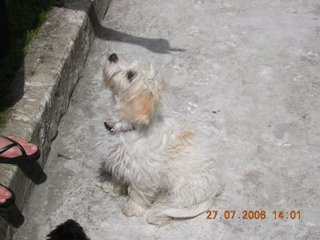
Look at the dog in the picture.  Imagine the trainer had said “Oops!” the moment the dog sat down in front of her, because the dog sat too slowly.

The next time the trainer asks for the cue the dog could offer an even slower sit, or perhaps offers another learned behavior like a down, or an alternate dog behavior like jumping up, whining, barking or growling. There is the possibility that the dog could offer a faster sit, but what if the dog doesn’t?

Perhaps the dog understands the concept of a NRM but superstitiously responds by acting as if it was the eye contact that was incorrect, perhaps the dog associates the punishment with being too close to the fence, or perhaps that he should not be in front of the trainer. Perhaps it was a combination? Perhaps the trainer does not want the dog to sit ever again, as when the dog had jumped on the trainer the NRM meant to never do that behavior ever again. 

Instead of using a NRM, the trainer could reinforce the dog’s fastest sits to build the muscle memory and a reinforcement history of the desired speed of sitting.  Instead of having the dog guessing about what he shouldn’t be doing, the trainer could reinforce him for doing what she wants him to be doing, and building a stimulus response association of only the correct behavior.  The trainer could set the dog up for success by making him more likely to sit fast by playing tug and getting the dog excited before asking for the cue, not asking for the behavior when the dog has just woken up from a nap and luring the dog into a fast sit with a treat until the dog is sitting at an appropriate speed prior to asking the cue.  

Classical Conditioning occurs in your training whether you like it or not.

If you say “down” and your dog sits, and then you say “wrong”, a secondary punisher follows the behavior of a sit.  This not only punishes a sit offered in response to the cue “down” but it also causes the behavior of siting to be conditioned with the secondary punisher.  This means that the next time you say “sit” your dogs brain might activate the memory of the NRM associated with the behavior in the past, and it could lead to confusion down the line as well as illicit a conditioned emotional response associated with punishment if NRM’s are often used in training.

In the video below Tedd Judd, PHD, Board Certified in Clinical Neuropsychology by the American Board of Professional Psychology, shares a great example of how using trial and error learning as opposed to errorless learning with an Amnesia patient caused the incorrect behavior to be more likely to occur in the future, rather than the desired one:


In the video Tedd Judd gives the example of a patient with Amnesia, in the hospital. The Doctor asks the patient, “Do you remember my name?” The patient says “No” and the doctors replies “Well, take a guess”, and the patient answers “Dr. Smith?”.  The doctor then answers, “No, It’s Dr. Judd”.  The next morning the Doctor asks the same question. “Do you remember my name?” and the patient replies “No”, and the doctor says “Can you take a guess?”, then the patient replies “Was it Dr. Smith?” Then the doctor replies, “No, it’s Doctor Judd”.  Then the next time the doctor goes past the patient the patient says “Oh, hi Dr. Smith!!!”  This happened because the patient was remembering their mistake, instead of the appropriate response. 

This same scenario can happen with dogs, a dog can remember and build muscle memory for the incorrect response even if a NRM was given.  With errorless learning where your goal is to shape successful approximations of the final behavior, the dog will not have the opportunity to think of, learn or practice incorrect responses.

An example of this is using trial and error training with No Reward Markers while teaching a dog to weave through agility poles.  During trial and error training the dog could zoom through the poles incorrectly, and you could say “Whoops!”, try again, and then the dog gets it right.  Perhaps you do 10 repetitions and the first time the dog was incorrect, then correct, then had 3 more errors, but then was successful the last 5 times.  It could seem that your dog has learned from his errors, however there is a higher possibility that the dog will repeat the mistakes he just repeated 4 times in the trial of 10 and than if you did 10 trials using errorless learning where the dog only make a mistake 1 out of 10 times.  This is because the dog has practiced doing the error more times.

Using a NRM in the middle of a behavior chain can not only punish the behavior in the chain, but can also punish the behaviors previously done in the chain, and can cause the cue to become poisoned (create a conditioned emotional response associated with punishment to the cue or the behavior). 

If you used a NRM for the dog exiting the weave poles in the middle of the poles, instead of completing the weaves correctly, and for some reason you had to use the NRM multiple times in this exact area of the weaves, your dog could start to have a conditioned emotional response associated with punishment when reaching that area of the weave poles that have been continually punished and your dogs behavior could change because of this conditioned response.

As Ted Turner, an internationally renowned Animal Behaviorist and marine mammal trainer says, regarding the use of punishment in training; when you reinforce your dog for something “you are putting money in a reinforcement account.   If you put a punishment in there, you drain your savings.  If you put too many punishments in there, there will be nothing to draw from.” 

In my opinion, it is easier to compete with the environment and distractions and be the most reinforcing option for your dog when you do not use punishers or conditioned punishers, as you have not “drawn from your reinforcement savings”.  To condition a behavior as secondary reinforcer (which means the animal will more readily do it without primary reinforcement in the future), stronger conditioning occurs if the behavior is only paired with reinforcement and never punishment, such as a NRM.  After many repetitions using errorless learning, the cues and behaviors your dog does should elicit a conditioned appetitive emotional response, in other words the dogs feels a similar feeling when he hears the cue of the behavior and completes the behavior to the feeling of being reinforced.

No one said training with errorless learning is easy.  It is much easier to watch an animal and say ‘yes’ when you like what they are doing and ‘no’ when you don’t like what the animal is doing.  It is much harder to create a training plan and adjust the plan using creative thinking when things go wrong.

In my opinion only the most talented trainers should implement such a complex method such as No Reward Markers into their training plans, and if the trainer is that talented, then they shouldn’t be making that many errors in the first place to need NRMs.

Read more

Selasa, 05 April 2016

Splash! wins Starpet 2008 in New York!

0

I will come back and post a video and more info. But Splash! and I had a blast in New York City!

Read more

Rabu, 30 Maret 2016

Being a new dog owner

0


Training your dog is beneficial to both you and your pet. The following tips will tell you the inside scoop on how to get your pup trained properly.

One of the ways to make a dog more easy to train is to have the dog fixed at six months. This should go hand in hand with the start of obedience classes. A newly neutered or spayed dog is more obedient. You will be able to better enjoy the time you have with your dog and they will be happy and healthy.


 Limit the duration of training sessions. Dogs can only handle a short amount of training at a time, so dont overdo it. Ten minutes is about the length of time a dog can handle.

 Use your dogs name whenever you are offering it a treat. If you want to have control of your dog, you have to teach him to respond to you. Get your dogs attention this way ten times every day. Also, on no occasion punish your dog if he comes running to you whenever you say his name.

 Six months is the recommended age at which a dog should be spayed or neutered. This is also a good time to begin obedience training classes. You dont want hormones to interfere with the learning process. You and your pet will enjoy a longer and happier life together.

 Reward your dog with high-quality treats when you are training him. A treat that is normally forbidden, such as table scraps or cheese, is a great choice.

 Make sure food and outside time are scheduled to help break your dog into being an inside dog. This can train your dog to whine or come get you when he feels the urge, so you can let him out and prevent him from doing his business inside. Having a regular schedule will help your dog know that a potty break will be coming, and he will hold learn to hold his bathroom urges until that time.

 The more active your dog is, the healthier it will be. Dogs get bored just as easily as children. Dogs that are bored are not easy to train. A dog that is happy, and gets the attention that they crave, will be a better behaved and attentive dog. Go on runs or long walks together.

 Give your dog a regular elimination and feeding schedule, so you can house train them. Your dog will adjust to the schedule and he will quickly learn that his outside time is when he should go to the bathroom. Using this schedule can teach your dog how to hold their piddle until the upcoming potty break.

 Stop your pup from chewing on an object that they shouldnt be if you catch them doing that. By doing this your puppy will learn which items he can and cannot chew then, when he is unsupervised, he will be less likely to chew your belongings.

 Your whole family should be involved with training the dog. The house rules and specific expectations will be more apparent to the new dog if everyone, not just the primary trainer, follows the same training procedures.

 Anxious dogs tend to chew things, including your upholstery. If you keep him in a crate and give him toys that are safe for him to chew on, your dog and your house will stay safe.

 Anxious dogs are prone to chewing on things they shouldnt. Dogs like to den up. Giving him a crate to lie in and a toy to chew on will make your dog feel secure and keep him occupied.

 Try training your dog to grab a toy and keep it in his mouth. When you see him mouth a toy, give him a reward or treat and use a clicker. After a few tries you should allow the dog to pick up the toy on his own. When he does, just click and then give a reward. After this, you should only reward your dog after he holds the toy in his mouth.

 Dog learn by doing the same thing over and over, and also by being rewarded. First, you must completely walk the dog through what you want to accomplish, and then set up a daily routine around the behavior that includes rewards. This is the right way in teaching a dog a new trick. Show your pet the right way through rewards and repetition.

 Keep your dog outside if you are not there. It will reduce the headache you get from the dogs uncontrollable chewing. If you dont have a safe place for your puppy outside, consider closing him in a room that doesnt have tempting things for him to get into.

 A new dog requires teaching proper obedience training right from the beginning. It is much easier to get a dog to learn the right way rather than making it unlearn its bad habits. If you never give your dog any scraps from table food, they will never start begging for it.

 The easiest way to keep your dog or new puppy from chewing up everything in the house while you are out is to keep him outdoors while you are gone. If this is not an option for you, the simplest way keep him from chewing is to close the doors to rooms that have appealing items and put other tempting items out of his reach.

 Feed your dog a healthy diet. If your dog isnt getting what he needs from his diet, he will have a hard time concentrating during training. Poor nutrition adversely affects your dogs health and can cause uncharacteristic behavior. A proper diet can affect how well they react to training.

 The best time to start training a dog is when its a puppy. While it isnt essential, a young dog will be easier to train. If you start training your dog when he is young, he will be almost as well-behaved as a child.

 When you get your puppy, be sure to create a bond to him by helping him learn his name. Repeat his name regularly, so he will learn to come to you when he hears it. These should be the primary words your dog needs to learn. Spending a lot of time interacting and playing with your puppy is the best way to establish a bond of love and trust. This will make him easier to train later.

 Understanding a dogs mentality and psyche are crucial to train a dog. When you know and understand this principle, you will be more successful in your efforts. Once someone knows a bit more about dogs, training becomes easier and more likely to work.

Read more

Minggu, 27 Maret 2016

New Puppy Shopping List

0


Coastal Pet New Earth Adjustable Personalized Soy Comfort Wrap Dog Harness in OliveCoastal Pet Metal Buckle Nylon Adjustable Personalized Dog Collar in Lime

Here is a list of basic supplies you may need and in most circumstances want to have when you get your first dog or puppy.

Buckle Collar - This will be kept on your dog to hold its ID tags so in case you pup gets out it will be returned to you.

Harness - is good for training because it takes pressure off the puppys neck and makes it easier to control. I have used both the 2 step harness and the typical harness. I prefer the 2-step harness for my puppy because it is easy to get her into it.

Coastal Pet Nylon Personalized Dog Leash in LimeLeash - I do not recommend a retractable leash. Well at least not for training. You dont have as much control over the dog and it makes it difficult to keep it close with its attention on you.

Retractable leashes are good for well trained dog that respond to voice commands almost immediately.

Pet Tags Lost Pet Recovery System - Silver HeartTags - I think that every dog should have a tag. If your pet goes missing it is a lot easier for a shelter or a person to just call your number. Instead of driving around town looking for LOST dog posters. I recommend getting a GPS tag if your dog is prone to running. There are quite a few options out there for that.

Loving Pets Espresso Bella Pet BowlFood Bowl - I recommend that if you have a dog that will be home alone and you want to have it on feed schedule that you get an automatic feeder. I enjoy having my dogs on a schedule because dogs like to have consistency in their lives and it keeps the dog more interested in treats when training because it is hungry. Stainless steel bowls are recommended because the scratches in a plastic bowl can harbor bacteria. 

Petmate Deluxe Fresh Flow 108 oz. Purifying Pet Fountain in Black Water Bowl - I like having a fountain water bowl for my dogs because it keeps it fresh and cool for my pets. So, I can rest assured that there arent any germs in their drink.

FURminator deShedding Tool for Medium DogsBrush -  I like the FURminator. It removes the rough undercoat and keeps my pets fur super shiny. I like that there is a button to push the fur off the brush. There is also a vacuum attachment so the hair doesnt go every where.

Bags on Board Rainbow Doggie Pick-Up Bags Refill Rolls

Waste Bags - I take them with me on every walk because I know my little trickster knows exactly when we are going home and loves to place a mine on the way back. I usually just take one with me and leave the rest at home. 

Blue Buffalo Wilderness Chicken Adult Dry Dog Food
Dog Food - I have been using Exceed, although I will be changing foods. I want to have a healthy dog to go run with me and I like to avoid high amounts of grain and by-products. Real food is the only way to go not a bag full of fillers. 

Blue Buffalo Wilderness Canned Dog FoodCanned Food - I feed my dogs both dry and wet food because dogs get most of there water from their food. I just mix in a little wet food with their night meal and call it a day. I again prefer more meat to by-products and fillers. 

Dog Gone Smart Red Rectangular Dog BedDog Bed - Dogs sleep 16 - 18 hours a day and need a place to rest and I am pretty sure I have spent a ton of money on dog beds. I would advice against getting a puppy an expensive bed because when it starts teething there wont be a bed there will be fluff all over your house. If you havent seen it yet I would look into the Dog Gone bed. It repels water mud and any bad smells that your dog may be carrying. 

Petco Premium 2-Door Dog Crates
Dog Crate - There are many different kinds of crates and deciding on one can be a pain. For a puppy I would suggest getting a plastic crate for two reasons. One they are easy to clean up and two when the puppy goes through the whining stage it is nearly impossible to get her to stop if she can see you through the wire walls. For a older dog that is house trained you can get a wire cage or a soft or wood cage. There are some dangers associated with a ire cage though as a  dog may try to fit his paw through the wiring and can injure himself in a panic. Wooden cages and soft cages are a pain to clean. Although wooden cages look very aesthetic they also come with a higher price.

Petmate Exercise Pen in BlackExercise Pen - I dont use mine as frequently as I used to as now that my dogs are house trained I dont have to worry to much about leaving them alone in a room and eliminating. I can just toss a few toys in there and leave them be a for a bit but I never leave them unattended for long.
North States Deluxe Decor Pet Gate
Simple Solution Extreme Stain & Odor Remover for PetsDog Gates - When bringing a new puppy home an entire house is a lot of ground to cover and it may make the dog feel overwhelmed. You can block of certain area from a dog or puppy with a simple gate or if you have a bigger entry way you can set up a fence of a sort. Then you can make certain areas ok and off limits to your new pet.

Odor Remover - Your new puppy is going to eliminate in the house. Its a guarantee she doesnt know any better she is just being a dog.  You probably should invest in something to clean it up though. And it should remove the pheromones so she isnt enticed to pee there again.

8 in 1 Perfect Coat Hypoallergenic Dog ConditionerDog Shampoo - Regular shampoo that we use has too high of a Ph for our pets and it can irritate their skin. There are special pet shampoos that can brighten their coat and keep its color looking nice as well as smelling good. Keeping everyone happy and clean.

Crazy Pet Train-Me Training Reward Dog TreatsDog Treats - I have worked with many a picky dog and I can exactly recommend a "one treat fits all dog" treat. So instead I just tell people to keep it safe make sure that there arent a ton of toxic things that dogs can digest. I can say that small treat are good for teaching basics but for more complex things a dog should get a more enticing treat but not necessarily bigger. I use actual chicken only for when I teach a new dog agility because if the dog doesnt want to do something it is less likely to do it again later. Two treats that I use are Sniffers 101 and Crazy Pets training treats because they are small and have variety.
Booda Fresh N Floss Spearmint 2-Knot Bones
Hyper Products Tennis BallsDog Toys - I like to have a variety of toys just like treats each toy has a different value to a dog. I have a chest full of toys and toys get switched in and out of the chest every month or so. It keeps your toy budget lower so your dog thinks he gets a new toy every month just make sure you wash them when you put them in storage. Pick plenty of plush toys, tugs and balls.

Booda Soft-Bite Terry Moose & Elephant Dog ToysJawz DiscDog Frisbee - Some dogs love to catch a disk and other dogs have to be trained to catch it and bring it back to you. Have some patience with your dog and you can enjoy Frisbee with your dog. If you decide to play Frisbee with your dog invest in a dog Frisbee it is gentler on their mouth and you can get some that are puncture resistant. The Hyperflite Jaws disc is super puncture resistant and is sure to last with your pet.
Extreme KONG Dog Toy
KONG - I am sure you have heard of them. Kong are easy to use to occupy your dog and keep them entertained for a while. Just fill it up with a few treats and then give it to them. Or just throw it to them and watch them chase after it while it bounces left and right. For tough chewers there are special black KONG and KONG Ballistic.

Nylabone Dental Dinosaur ChewChews - Puppies that are teething or dogs that just like to chew need some way to outlet that. I recommend Nylabones because they are safer than real bones and dont shatter. Also you can pick what flavor you get the bone in as well as what size and know that your dog will love it. Beside which dog wouldnt love to chew on a dinosaur. And it cleans their teeth.

Greenies Dental Treats for Dogs LargeDoggie Dental - In my experience I have seen that most dogs dont like having their teeth brushed but that smell is terrible. So their are substitutes for a dog that hasnt been taught to brush his teeth. There are some water add as well as gels and bones that clean dogs teeth.


Petco Eye WipesEye Care - If your dog gets tear stains then you should invest in some sort of tear stain remover. I recommend wipes because they are there when you need them without any mess. And you can use them to clean up what you cant with the shampoo in the bath.


Healthy Select Ear Wash for DogsEar Care - Dogs can get infections in their ears just like we can but with the proper care that stench can be avoided, trust me its bad. There are three things that you need to clean a dogs ears. One you need to get an ear cleansing liquid, two you need a ear powder to dry the ear out and three a wipe for the outer ear.

Millers Forge Guillotine Style Pet Nail ClippersNail Care - If dogs nails are not maintained they can cause a great deal of pain to your pet. But before cutting your dogs nails you should invest in some styptic powder in case the nail is cut to short and the nail starts to bleed. And then pick the nail clippers of your choice. I personally feel more comfortable with the guillotine clippers but if it doesnt feel right dont get them.

Sentry FIPROGUARD MAX Dog & Puppy Topical Flea & Tick TreatmentFLEA & TICK -  If you plan on taking your dog any where you should definitely invest in a flea and tick preventive mainly because they are not easy to handle after you have them in your house.


Read more

 
Powered by Blogger